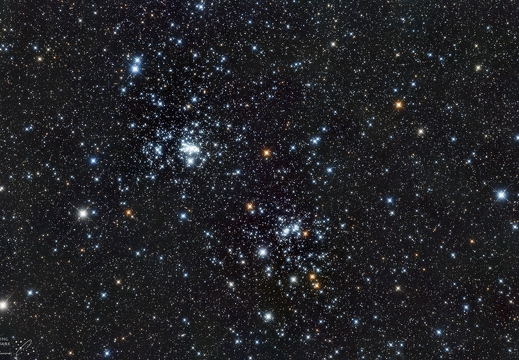
Podwójna gromada NGC 869 i NGC 884
The Double Cluster in Perseus (NGC 869 and NGC 884)
The Double Cluster in Perseus consists of two young open star clusters - NGC 869 and NGC 884 - located in the constellation Perseus, about 7,500 light-years away from Earth. Both clusters are physically related, having formed around the same time (approximately 13 million years ago) and belonging to the Perseus Arm of our Galaxy.
Through binoculars or a wide-field telescope, they appear as a stunning, nearly symmetrical pair, visible even to the naked eye from dark locations as a faint patch of light near the star Mirfak (α Persei). Their combined apparent brightness is about magnitude 4.3, and each cluster spans roughly 30 arcminutes, about the same apparent size as the full Moon. They contain hundreds of hot, blue B-type stars and reveal an impressive richness of color and structure in larger telescopes.
The Double Cluster was first catalogued by the Greek astronomer Hipparchus, although it was certainly known and observed long before his time, since it is visible to the naked eye.
In Greek mythology, Perseus was the hero who slew Medusa and rescued Andromeda from a sea monster. The constellation that bears his name commemorates his deeds and connects him to other celestial figures: Andromeda, Cassiopeia, Cepheus, and Pegasus. The Double Cluster, shining within his “sword,” can thus be seen as a celestial jewel, a glittering echo of ancient myths preserved in the stars.
90x120 sec under the Bortle 7 + moon 60%
Telescope: Newtonian 6" F/5 + ZWO ASI 2600 MC Pro
guiding: OAG + ZWO ASI 220
Mount: SW Wave 150i.
Driven by Stellarmate, stacked in Pixinsight.
sobota, 27 września 2025
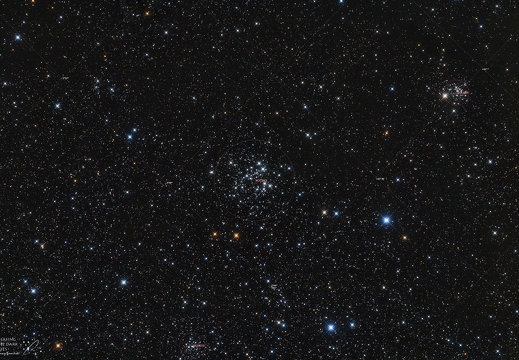
NGC 663, NGC 654 and NGC 659
NGC 663, NGC 654 and NGC 659 – open clusters in Cassiopeia
At the center of the image lies NGC 663 (also known as Caldwell 10), a young open cluster in the constellation of Cassiopeia, about 6,800 light years away. It contains roughly 400 stars and is about 20–25 million years old. Its bright blue B-type stars include several rare Be stars, which spin so fast they form gaseous rings around themselves.
In the same field of view, two smaller clusters can also be seen – NGC 654 on the right side and NGC 659 sticking to the bottom. All three are part of the Cassiopeia OB8 stellar association in the Perseus Arm of the Milky Way and likely formed around the same time. Together they create a striking group of young clusters often captured in a single wide-field image.
60x120 sec under the Bortle 7 + moon 60%
Telescope: Newtonian 6" F/5 + ZWO ASI 2600 MC Pro
guiding: OAG + ZWO ASI 220
Mount: SW Wave 150i.
Driven by Stellarmate, stacked in Pixinsight.
sobota, 27 września 2025
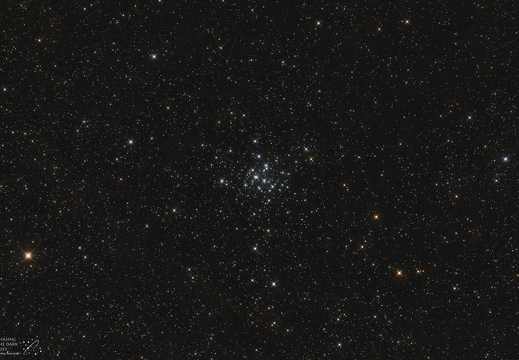
M36
Messier 36 – gromada Wiatraczek (NGC 1960)
60x120 sec
piątek, 26 września 2025
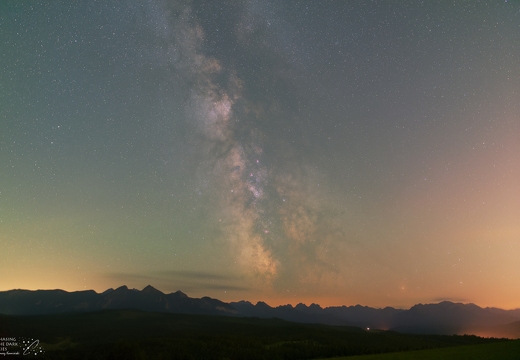
Droga Mleczna
Droga Mleczna nad Tatrami
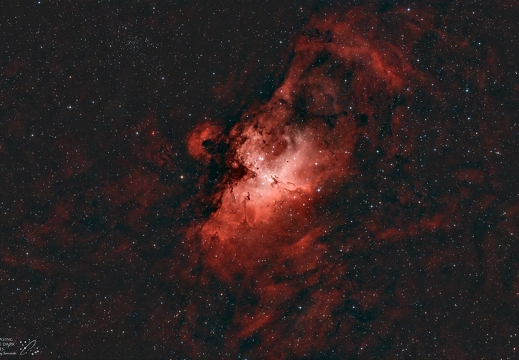
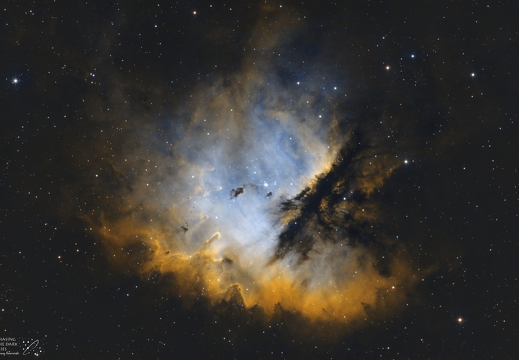
M16 - Mgławica Orzeł
środa, 2 lipca 2025
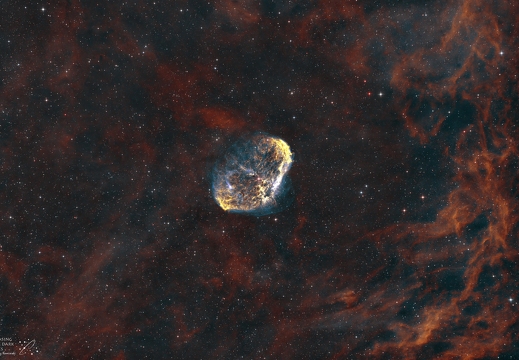
NGC 6888 - Mgławica Półksiężyc
sobota, 14 czerwca 2025
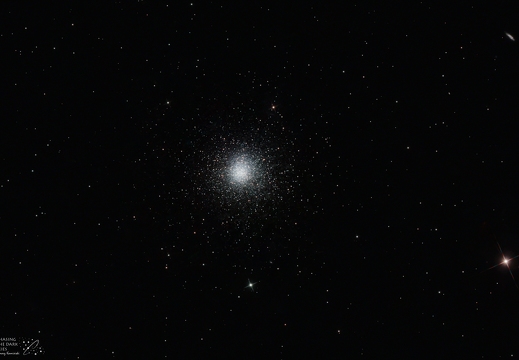
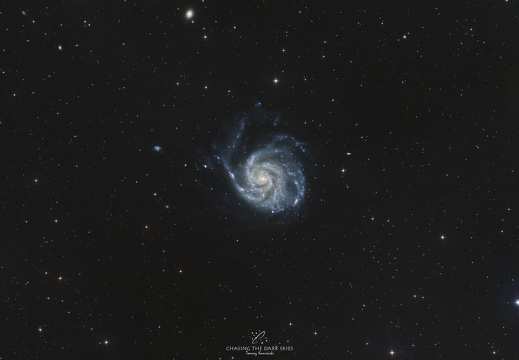
M101 - Wiatraczek
piątek, 2 maja 2025